
Every Dog Walk Has an Environmental Cost — Here’s What to Do About It
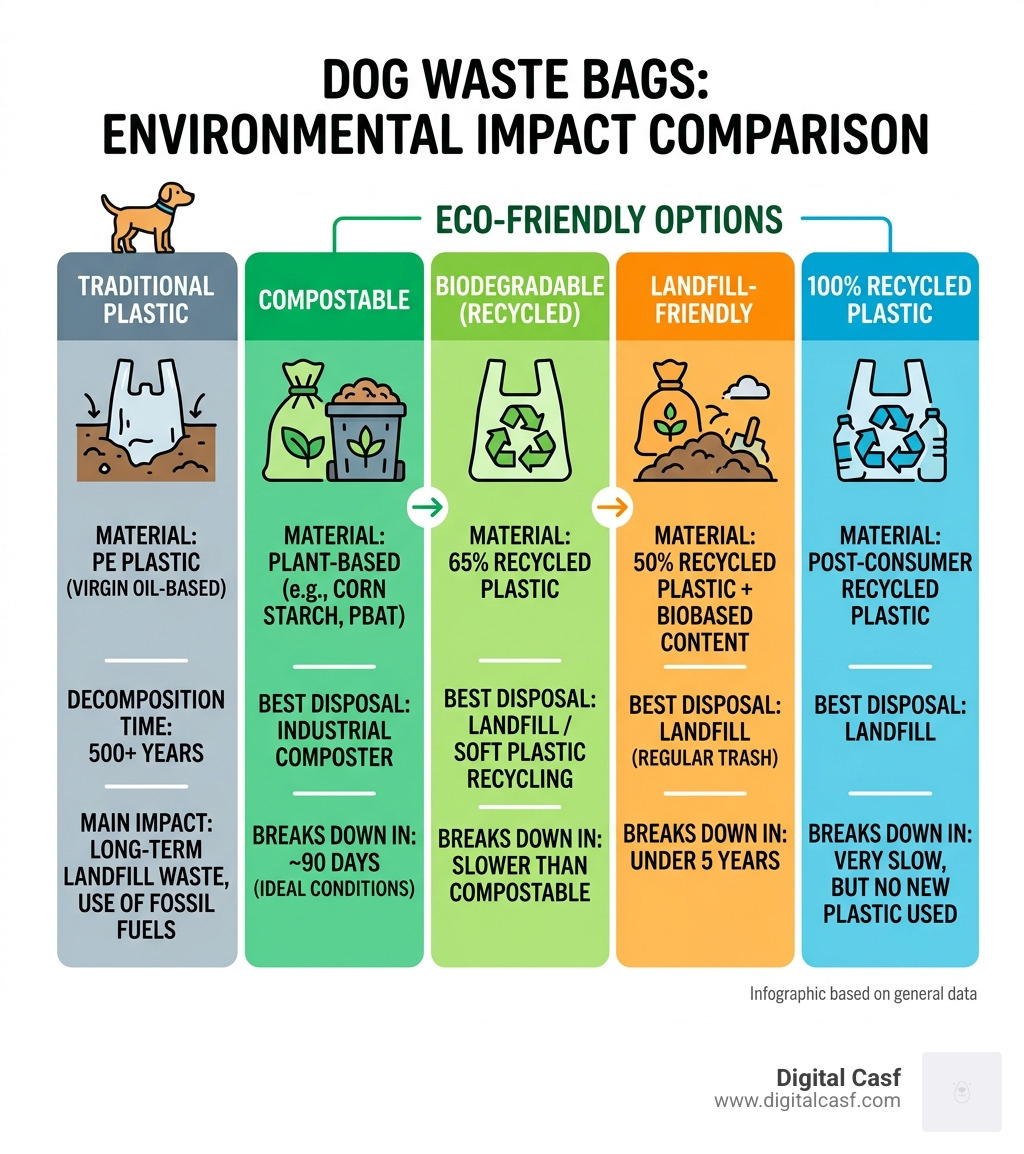
Eco friendly dog waste bags are bags designed to reduce the environmental harm caused by traditional plastic poop bags, which can take over 500 years to break down in a landfill.
Here’s a quick overview of your main options:
| Type | Material | Best Disposed In | Breaks Down In |
|---|---|---|---|
| Compostable | Corn starch, PBAT | Industrial composter | ~90 days (ideal conditions) |
| Biodegradable (recycled plastic) | 65% recycled plastic | Landfill / soft plastic recycling | Slower than compostable |
| Landfill-Friendly | 50% recycled plastic + biobased content | Landfill (regular trash) | Under 5 years |
| 100% Recycled Plastic | Post-consumer recycled plastic | Landfill | Very slow, but no new plastic used |
Most dog owners don’t think twice about the bag they grab on a morning walk. But those small bags add up fast — and most end up sitting in landfills for centuries.
Traditional plastic poop bags can linger in landfills for 500+ years. Yet only around 9% of plastic gets recycled each year. That means the vast majority of bags — eco-friendly or not — end up buried underground.
The good news? There are now several genuinely better options. Some break down in months. Some are made from waste plastic that would otherwise sit in a landfill anyway. Others are engineered specifically to decompose in the oxygen-starved environment of a landfill.
The tricky part is knowing which claims to trust — because not all “eco-friendly” labels mean the same thing.
Understanding the Different Types of Eco Friendly Dog Waste Bags
When we talk about eco friendly dog waste bags, we aren’t just talking about one single product. In April 2026, the market has evolved to offer several distinct technologies, each designed for a different disposal “end-of-life” scenario.
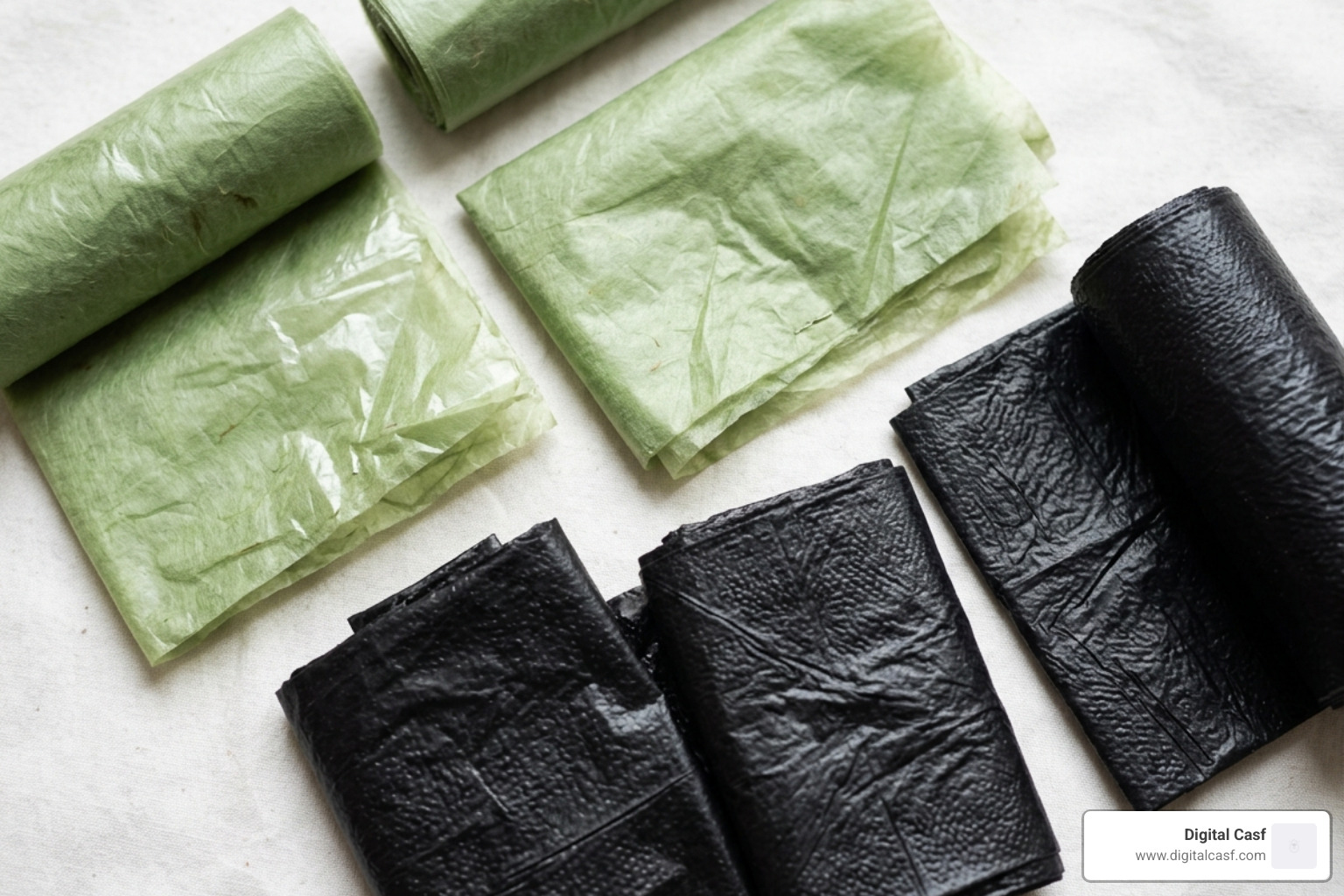
- Compostable Bags: These are the “gold standard” for circularity. Made from plant-based materials, they are designed to break down completely into organic matter. However, they require specific conditions (heat, moisture, and microbes) to do their job.
- Biodegradable Options: This is a broad term. Some biodegradable bags are made from recycled plastic with additives that help them break down faster than standard plastic. Others are entirely plant-based.
- Recycled Plastic Bags: These focus on the “Reduce and Reuse” part of the eco-equation. By using 100% recycled materials, these bags prevent millions of pounds of plastic from entering landfills as “new” waste.
- Landfill-Friendly Technology: This is a newer category. Since most of us simply toss poop bags into the nearest park bin or our home trash, these bags are engineered to decompose in the oxygen-starved (anaerobic) environment of a landfill.
Materials Used in Eco Friendly Dog Waste Bags
What exactly are you holding in your hand? Most high-quality eco friendly dog waste bags move away from pure petroleum-based plastics.
Common materials include corn starch, which is often blended with PBAT (a biodegradable polymer) and vegetable oils to create a flexible, plastic-like feel. For recycled options, manufacturers often use post-consumer recycled plastic, sometimes reaching up to 65% or even 100% recycled content.
We’ve seen a shift toward biobased content—materials derived from renewable biological sources. A key metric for quality is thickness; many premium compostable bags are around 0.71mil thick. This thickness is crucial because it ensures the bag feels sturdy—often described as having the tactile strength of a water balloon—rather than a thin, flimsy film.
Performance and Durability Standards
Being green shouldn’t mean getting poop on your hands. We believe sustainability must be practical. A bag that rips is a bag that fails, regardless of its carbon footprint.
Modern eco friendly dog waste bags are designed to be 100% leak-proof and puncture-resistant. High-quality options feature gusseted side panels that expand to hold a significant volume—often up to a 2.5-quart capacity (about half a gallon). This ensures they can handle waste from the “teeniest sausage dog to the greatest Great Dane.”
Furthermore, thickness (often between 15 and 20 microns) provides a physical barrier against nasty smells. While some bags are scented with lavender to mask odors, many users find that a thick, unscented recycled bag traps odors just as effectively by simply being airtight.
Compostable vs. Biodegradable: Why the Distinction Matters
This is where many pet parents get confused. While the terms are often used interchangeably, they mean very different things for the planet.
| Feature | Compostable Bags | Biodegradable Bags |
|---|---|---|
| Primary Goal | Turn into nutrient-rich soil | Break down into smaller pieces |
| Environment | Needs oxygen & high heat (Compost) | Can happen anywhere (eventually) |
| Timeframe | ~90 to 180 days | Years to decades |
| Byproducts | Humus, CO2, Water | Can leave microplastics (if not certified) |
The distinction is vital because of methane production. If you take a compostable bag (designed for oxygen-rich environments) and bury it in a landfill (where there is no oxygen), it may struggle to break down and can actually produce methane, a potent greenhouse gas.
The Reality of Industrial Composting for Pet Waste
You might think, “I’ll just buy compostable bags and put them in my green bin!” Slow down. Most municipal yard waste or food scrap programs do not accept pet waste.
Dog poop contains pathogens and parasites that require very high, sustained temperatures to kill—temperatures that many home compost piles never reach. Because of these pathogen risks, only a tiny number of industrial composters currently accept pet waste. Always check your local regulations before adding pet waste to a compost stream. Look for the EN13432 standard or OK COMPOST certification to ensure the bag itself is capable of breaking down, but remember the waste inside is a different story.
Why Some Biodegradable Claims are Misleading
Beware of “oxo-degradable” plastics. These are traditional plastics with chemical additives designed to make the bag fragment faster. The problem? They often just turn into millions of tiny microplastics.
Greenwashing terms like “earth-friendly” or “degradable” without specific certifications can be marketing traps. Truly compostable products should meet ASTM D6400 standards, which prove they won’t leave toxic residues behind.
The Science of Landfill-Friendly Technology and Microplastics
Since the reality is that most pet waste ends up in a landfill, “landfill-friendly” technology has become a game-changer.
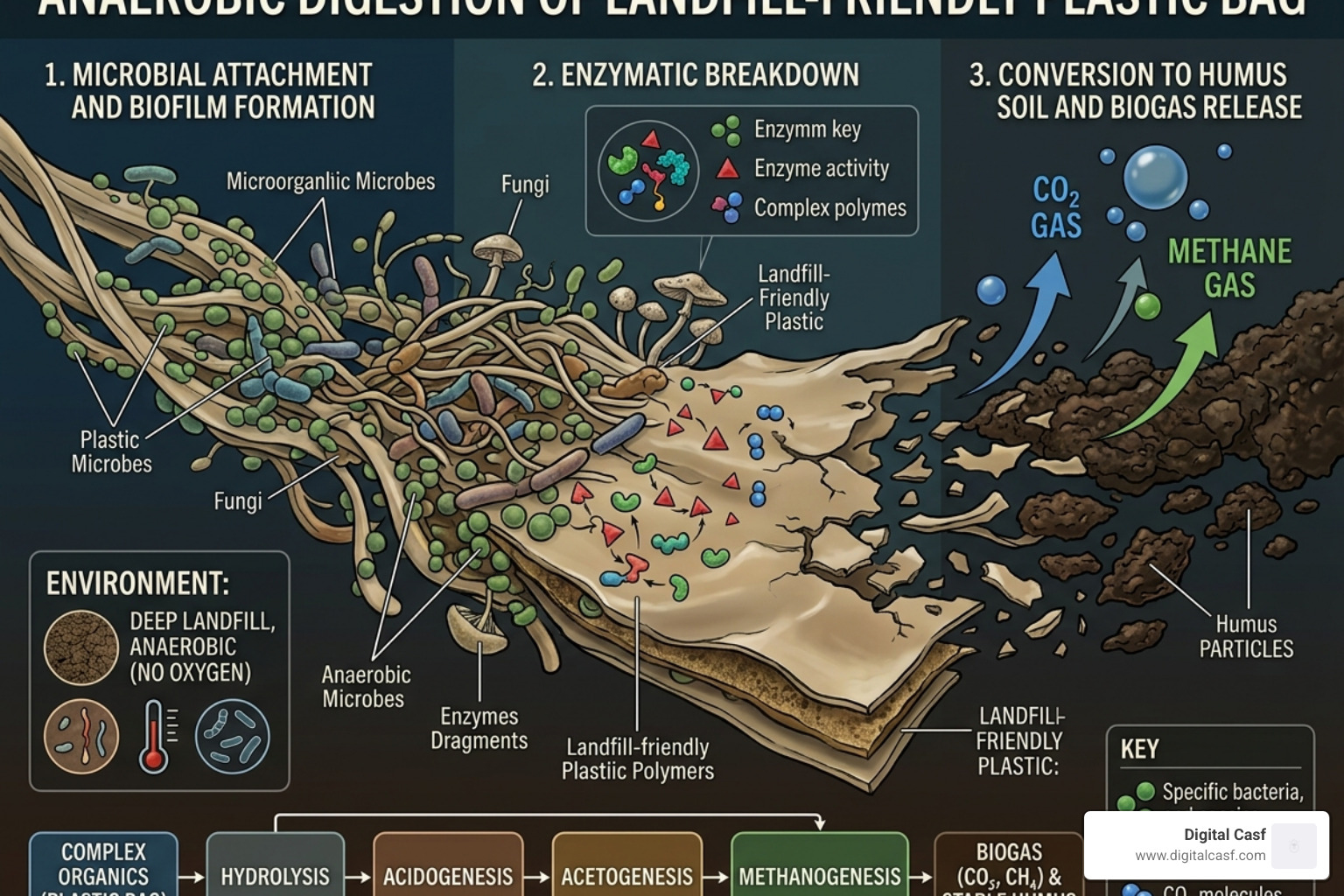
This technology, such as Plasgreen, uses organic additives that send a “chemical signal” to microbes in a landfill. In an oxygen-starved (anaerobic) environment, these microbes are attracted to the plastic and begin to consume it. While a typical plastic bag might linger for 500 years, these engineered bags can decompose up to 300X faster, often disappearing in less than five years.
Eliminating the Microplastic Threat
The goal of modern eco-engineering is a clean breakdown. Unlike older technologies that simply caused plastic to shatter into smaller pieces, landfill-friendly bags undergo molecular digestion. The microbes convert the material into humus (organic soil matter), CO2, and methane.
In many modern landfills, this methane is captured and turned into bioenergy, heating homes and powering grids. This turns a waste product into a resource. Look for the Intertek Green Leaf or Global Recycled Standard (GRS) marks to verify these claims.
Comparing Recycled Plastic to Plant-Based Polymers
Is recycled plastic better than corn starch? It depends on your perspective.
- Recycled Plastic: Reuses existing waste. Since only 9% of plastic is recycled annually, using 65% to 100% recycled content helps create a “circular economy” and reduces the need for new fossil fuels.
- Plant-Based Polymers: These are renewable and often have a lower carbon footprint during production, but they can be more sensitive to heat and moisture during storage.
Both are massive improvements over “virgin” plastic, which requires the extraction of new oil.
Proper Disposal and Avoiding Greenwashing Claims
Choosing the right eco friendly dog waste bags is only half the battle; you also have to dispose of them correctly.
- Compostable Bags: Best if you have access to a specialist pet waste composting service.
- Landfill-Friendly/Recycled Bags: These go in your regular trash. Do not put them in recycling bins, as pet waste contaminates the recycling stream.
- Home Composting: Only do this if you have a dedicated “pet waste only” bin and do not use the resulting compost on edible plants (vegetable gardens).
Identifying Genuine Eco Friendly Dog Waste Bags
Don’t just take the box’s word for it. Check for third-party verifications:
- ASTM D5511-18: The standard for determining anaerobic biodegradation in landfill conditions.
- BPI Compostable: Ensures the bag meets North American composting standards.
- USDA Biobased: Shows what percentage of the bag comes from renewable biological sources.
- Seedling Logo: A European certification for compostability.
Common Marketing Traps to Avoid
“Degradable” is a red flag. Everything is “degradable” if you wait a thousand years. Without a specific timeframe or certification (like “decomposes in 90 days” or “ASTM D5511 certified”), the claim is likely hollow. Also, be wary of “hidden plastics”—some bags claim to be “plant-based” but only contain a small percentage of plants mixed with traditional polyethylene.
Frequently Asked Questions about Eco Friendly Dog Waste Bags
Are eco-friendly bags more expensive than traditional plastic?
Initially, yes. Plant-based resins and recycled materials cost more to process than raw oil. However, the price-per-bag has dropped significantly as adoption grows. Buying in bulk (packs of 200 or 900) often brings the cost down to just a few cents per bag. When you factor in the “environmental cost” of a bag that lasts 500 years, the long-term value of eco-friendly options is much higher.
Do compostable bags break down in a regular landfill?
Not effectively. Landfills are designed to be dry and airless to prevent rot and odors. Compostable bags need oxygen and moisture to break down. In a landfill, they may sit mummified for years or produce methane. If you know your waste goes to a landfill, a landfill-friendly bag is actually a smarter choice than a compostable one.
How long can I store eco-friendly bags before they degrade?
Compostable bags have a shelf life. Because they are designed to break down, exposure to high heat or moisture in your garage can cause them to become brittle or start decomposing prematurely. We recommend a 12-month rotation—buy what you need for the year and store them in a cool, dry place. Landfill-friendly bags made with recycled plastic typically have an unlimited shelf life until they reach the landfill.
Conclusion
At Digital Casf, we believe that “Caring for Pets” must go hand-in-hand with “Caring for the Planet.” Every time you pick up after your dog, you have a choice. You can contribute to a 500-year pollution problem, or you can support a circular economy that uses recycled materials and smart decomposition technology.
By choosing certified eco friendly dog waste bags, you are taking a small but significant step toward environmental stewardship. Whether you opt for compostable corn starch or landfill-optimized recycled plastic, you’re helping ensure that our parks and trails stay clean for generations of wagging tails to come.
Learn more about our mission and explore our range of sustainable pet products at Caring for Pets and the Planet.
